
MUSIC
THERAPY
For kids and adults whose brains work differently — and the families who love them.
Music therapy for children and adults with ADHD, autism, developmental disabilities, and more — offered in Dover, NH, throughout the Seacoast, and in the home when appropriate.
Music Therapy Can Help With…
-
Music therapy helps children with ADHD who have big reactions — meltdowns, outbursts, explosive moments — learn to recognize and manage their emotions before they hit that wall.
The natural structure of rhythm and music also helps build impulse control, so kids can pause before they act.
-
Music therapy meets autistic children and adults exactly where they are. Music deepens social connection, builds emotional awareness, and creates a predictable, safe space where engagement feels natural — not forced.
For those who are nonverbal or have limited communication, music offers a way to connect and express without words.
-
Music therapy helps children with sensory processing challenges who need time and space to adjust to new environments and input — sessions are paced around your child's comfort, never rushed.
-
Music therapy helps children with developmental disabilities who need support with motor skills, communication, and social development — but who also need therapy to actually be fun.
When kids are engaged and motivated, the real work happens. Music makes that possible
-
Music therapy helps children and adults who carry anxiety like a weight they can't put down — the constant worry, the school refusal, the stomachaches before something new.
Music creates a predictable, safe space where the nervous system can regulate, through guided music and meditation, breathwork, and songwriting as emotional expression.
-
Music therapy helps adults recovering from stroke or brain injury who need to retrain their brains and rebuild lost skills.
Music is uniquely wired into the brain — rhythm, melody, and beat activate neural pathways that other therapies can't always reach, opening new routes to recovery.
-
Music therapy helps seniors who are feeling isolated — or who are drifting in and out of reality — reconnect.
A familiar song can reach someone that nothing else can. We've watched residents light up, remember, and come back to themselves, even if just for a moment.
-
Music therapy helps children and adults in hospice and palliative care find acceptance in the dying process — and creates meaningful moments of peace for both the person and the people who love them.
When there are no more words left, music provides an everlasting connection.
-
Music therapy helps adults who carry everyday stress find a creative outlet that actually lets them exhale.
No musical experience needed — just a willingness to show up and let music do what words sometimes can't.
-
Music therapy helps children and adults who have been told they're too much, not enough.
Strength-based music therapy offers opportunities for quick successes, growing confidence quickly.
What is Music
Therapy?
Music Therapy is one of several creative arts therapies that promotes a person’s physical and emotional wellbeing. Music therapy uses music to engage people in self-exploration, growth, and development of meaningful skills in their daily life.
Music therapists support people across the life span in emotional, interpersonal, communicative, cognitive, and physical domains. Like talk therapy, it can provide a secure and stable environment for connection.
Don’t worry, you do not need to have any musical skills or experience making music to participate in music therapy sessions. We will incorporate lots of ways to engage with music during a session. We will talk, sing, improvise, play a variety of instruments, listen to music, move to music, write songs, recreate existing songs, and create art as a reflection of music.
What We Do In A Music Therapy Session
-
Singing is one of the most natural and accessible ways to engage in music therapy.
We use singing to support speech and language development, strengthen breath control, build vocal expression, and create moments of connection and joy.
-
Picking up an instrument — even for the first time — opens a door to self-expression that words sometimes can't.
We use improvisation and instrument play to build fine and gross motor skills, develop focus and attention, encourage creative risk-taking, and give clients a way to communicate feelings through sound rather than language.
-
Writing a song is one of the most powerful therapeutic tools we have. It gives clients a way to name their experiences, process difficult emotions, and tell their own story.
Songwriting builds confidence, strengthens language and literacy skills, and creates something lasting that belongs entirely to the person who made it.
-
Rhythm is one of the most fundamental elements of music and has several therapeutic benefits.
Rhythm games help build impulse control, improve attention and focus, strengthen sequencing and memory skills, and support motor coordination.
They're also genuinely fun, which means clients stay engaged and the work gets done.
-
Music listening is more than just putting on a song. In music therapy, we are intentional with music selections, using client-preferred music to support emotional regulation, reduce anxiety, improve focus, and create a safe space for reflection.
Clients learn to identify how different music affects their mood and body, building self-awareness and coping skills they can use outside of sessions.
-
Movement to music connects the body and the brain in ways that sitting still simply can't.
We use rhythm and music to support gross motor development, improve coordination and balance, build body awareness, and regulate the nervous system.
Music is an entry point for initiating movement when getting started is difficult.
-
Music and art together create a uniquely powerful therapeutic experience.
When clients combine musical expression with visual art, they engage multiple senses simultaneously, opening new pathways for communication, emotional processing, and creative self-expression.
Music & Art Making is especially effective for clients who benefit from a multimodal approach.
-
Music has a unique ability to put words to feelings that are hard to express directly.
In lyric analysis, clients listen to and discuss the meaning of song lyrics — exploring themes, emotions, and discovering what resonates with them personally.
It's a gentle, indirect way to approach difficult topics, making it particularly effective for adolescents and adults who find direct conversation challenging.
-
Music has a profound effect on the nervous system.
In music therapy, we use guided music and mindfulness techniques — including breathwork, progressive muscle relaxation, and music-assisted meditation — to reduce anxiety, lower stress, and support emotional regulation.
Clients leave sessions with tools they can return to on their own, building a personal practice of calm.
-
Music and memory are deeply connected in the brain. We use music-based sequencing and memory games to strengthen cognitive skills including attention, working memory, and processing speed.
For children, these activities build foundational learning skills in an engaging, motivating way.
For adults recovering from stroke, brain injury, or living with dementia, music-based memory work can help maintain and rebuild cognitive function in ways that feel meaningful rather than clinical.
How It Works
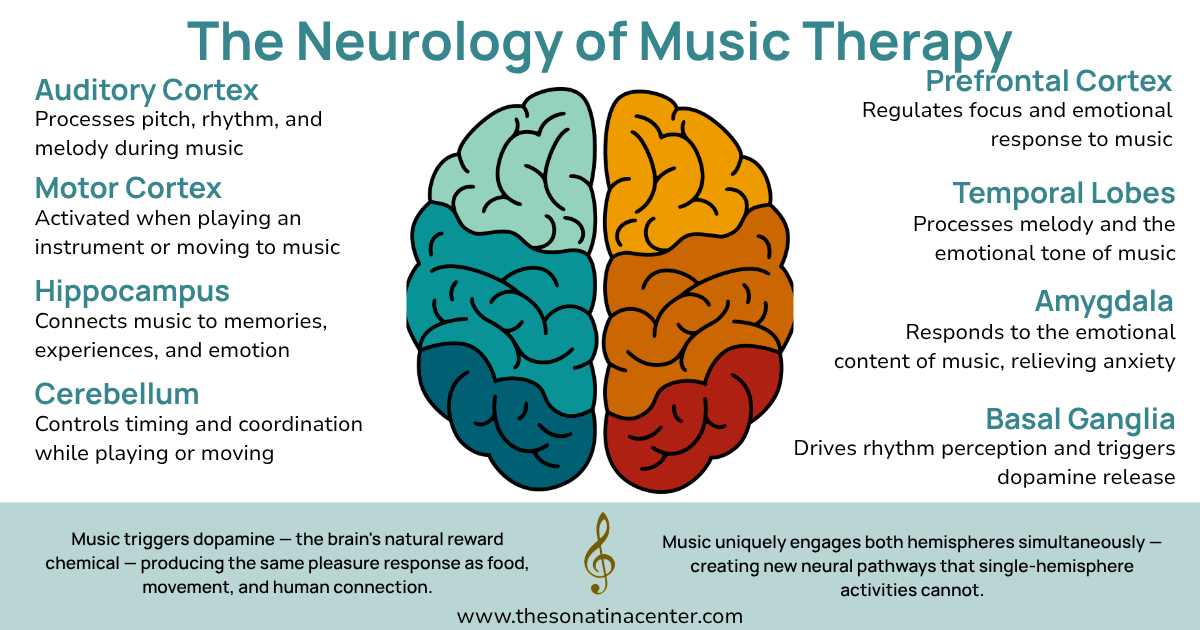
Creating and listening to music is a whole brain activity.
Getting Started is Free
Every new client starts with a free twenty (20) minute phone consultation. Our Intake Coordinator will review our process and policies with you and gather information to determine if music therapy may be a good fit. The phone consultation serves as an opportunity for you to ask questions about services and gain a deeper understanding of the music therapy process.
What To Expect
Individual sessions are offered in 45- or 60-minute sessions. Sessions are provided at The Sonatina Center in Dover, NH, at partner locations throughout the Seacoast region, and in the home when appropriate.
New clients begin with an intake session — an evaluation of up to one hour where your therapist will assess your strengths and areas of need and develop an individualized goal plan to review with you. Progress is reviewed quarterly.
INVESTMENT
Our fees are $150 for the initial Music Therapy Evaluation and $120/hr for follow-up sessions. Fees are reviewed annually and you'll always be informed of any changes in advance. View our full list of current service rates here.
Interested in group music therapy?
View our currently offered groups.
SCHOLARSHIPS & ACCESSIBILITY
Free Sessions for BIPOC Clients
The Sonatina Center is committed to bridging the gap of accessibility for the Black, Indigenous, and People of Color community. We offer free individual music therapy sessions to any BIPOC client. Availability is currently limited to 6 scholarships and we have a waiting list. Please contact us for more information.