
ART
THERAPY
Art therapy for children and adults navigating trauma, anxiety, emotional dysregulation, and more — offered in Dover, NH, throughout the Seacoast, and in the home when appropriate.
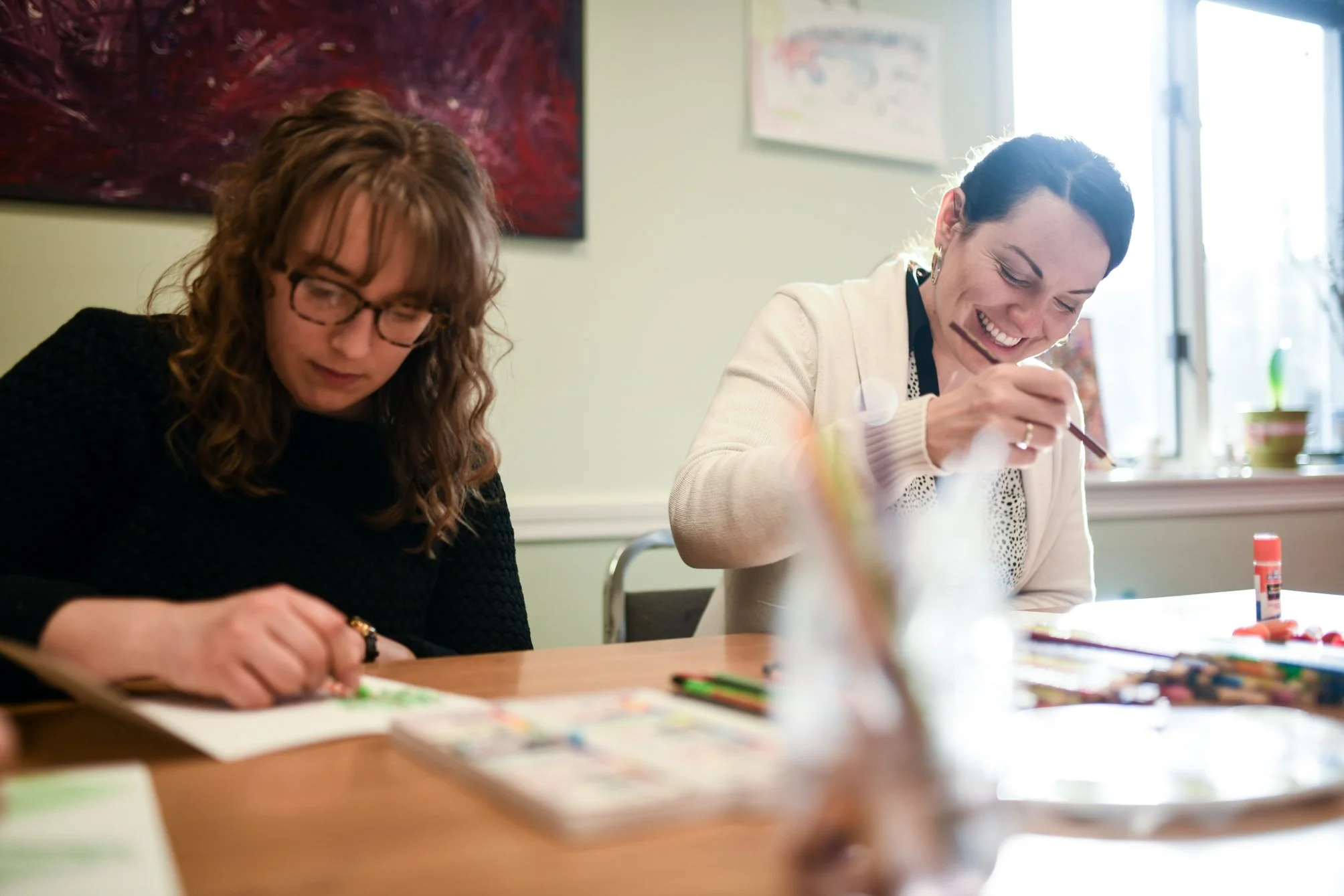
Some people process better when their hands are creating.
Art Therapy Can Help With…
-
Art therapy gives anxiety somewhere to go.
When worry lives in the body and the mind won't quiet down, making something — drawing, painting, collaging — can create enough distance to start looking at what's underneath.
Our art therapists work with children and adults to explore anxiety through the creative process, building awareness and coping skills that carry into everyday life.
-
For kids and adults who feel things intensely, art therapy offers a way to slow down and work with those emotions rather than be overwhelmed by them.
The creative process itself — choosing colors, making marks, deciding what goes where — builds the kind of self-awareness and control that regulation requires.
Our art therapists help clients develop tools they can use in session and reach for when things get hard.
-
Art therapy is a natural fit for ADHD. The hands-on, creative nature of the work meets clients where they are — providing enough stimulation to stay engaged while building focus, impulse control, and self-expression.
Our art therapists work with children and adults with ADHD to channel energy productively, develop emotional awareness, and strengthen the skills that make daily life more manageable.
-
Depression often makes it hard to find words — or the motivation to look for them. Art therapy offers a low-pressure way to engage, express, and slowly reconnect with a sense of self.
The act of making something, however small, can be a meaningful step.Our art therapists work with children and adults navigating depression to rebuild connection, process difficult emotions, and find moments of agency in the creative process.
-
Trauma lives in the body and the nervous system — often in places words can't easily reach.
Art therapy offers a way to approach traumatic experiences indirectly, through image-making and creative expression, without requiring clients to narrate what happened before they're ready.
Our art therapists are trained in trauma-informed approaches that prioritize safety first. We work at the client's pace, using the creative process to help process, integrate, and heal.
-
Recovery is about more than stopping — it's about understanding what was underneath, rebuilding identity, and finding new ways to cope.
Art therapy gives clients in recovery a nonjudgmental space to explore those questions through the creative process.
Our art therapists work with adults navigating addiction and recovery to process emotions, examine patterns, and develop a stronger sense of self that supports lasting change.
-
How we see ourselves shapes everything — how we move through relationships, how we handle setbacks, how much space we feel we're allowed to take up.
Art therapy gives clients a way to explore identity and self-perception through creative expression, often surfacing things that are hard to access through conversation alone.
Our art therapists work with children and adults to build a clearer, more grounded sense of who they are.
-
Grief doesn't follow a timeline, and it doesn't always respond to words.
Art therapy gives people a way to hold and express what they're carrying — through image, symbol, and the act of making — without having to explain it or organize it into language first.
Our art therapists work with children and adults navigating loss of all kinds, supporting them through the process at whatever pace feels right.
-
Art therapy isn't only for crisis. For people who want a regular space to decompress, process, and reconnect with themselves, the creative process can be genuinely restorative.
Our art therapists work with clients who are managing the weight of everyday life — work, relationships, transitions, the general accumulation of stress — and who want something more than talking about it.
-
Art therapy is accessible in ways that many other therapeutic approaches aren't.
For clients with intellectual and developmental disabilities, creative expression offers a meaningful way to communicate, connect, and grow — regardless of ability.
Our art therapists adapt their approach to meet each client where they are, focusing on self-expression, emotional awareness, and quality of life.
-
Art therapy has a unique role in memory care. Creative expression often remains accessible even as memory and language fade, offering a way to connect, communicate, and experience moments of joy and meaning.
Our art therapists work with individuals living with Alzheimer's and dementia, as well as their families, providing a space where expression and connection are still possible.
-
At the end of life, art therapy offers something words often can't. Legacy projects, life review, and expressive work give clients and their families a way to process, reflect, and leave something behind.
Our art therapists provide gentle, client-led support for individuals in hospice and palliative care — and for the people who love them.
What is
Art Therapy?
Art therapy is one of several creative arts therapies that uses the process of making art to support emotional, psychological, and relational wellbeing. You don't need to have any artistic skill or experience — the focus is never on the quality of what you make, but on what the creative process opens up.
At The Sonatina Center, our art therapists are also licensed mental health counselors, which means they bring the full scope of clinical mental health services to every session. In addition to art-based approaches, they can diagnose and treat mental health conditions, administer psychological assessments, screen for suicidality, and provide psychoeducation to clients and families.
If you're not sure whether art therapy, music therapy, or counseling is the right fit, we're happy to talk it through during your free consultation.
What We Do In An Art Therapy Session
-
Painting and drawing are the foundation of art therapy practice.
Our art therapists use these core modalities to help clients express emotions, explore identity, and process experiences that are difficult to put into words.
No artistic skill is needed — what matters is what emerges on the page.
-
Collage involves selecting, cutting, and arranging images and materials to create something new.
For clients who feel intimidated by a blank canvas, collage offers a lower-pressure entry point into creative expression — and often surfaces themes and feelings that surprise even the client.
It's particularly useful for identity work, life transitions, and processing complex emotions.
-
Altered book making takes an existing book and transforms it — through painting, collaging, writing, and layering — into something personal and meaningful.
The process of taking something already written and making it your own can be a powerful metaphor for clients working through their own stories.
-
Working in three dimensions — with clay, found objects, fabric, and other materials — engages the body in the creative process in a way that two-dimensional work doesn't.
Our art therapists use sculpture and mixed media with clients who benefit from tactile, hands-on engagement, and for whom the physical act of making is itself therapeutic.
-
Masks have been used across cultures for centuries to explore identity, emotion, and transformation.
In art therapy, mask making gives clients a way to examine how they present themselves to the world versus how they feel on the inside — a distinction that is especially meaningful for clients working through trauma, identity, or self-esteem.
-
Creating mandalas and repetitive patterns is naturally calming to the nervous system.
Our art therapists use this approach with clients who need help regulating anxiety, managing overwhelming emotion, or simply slowing down.
The structured, contained nature of the work provides a sense of order and safety that supports deeper therapeutic exploration.
-
Bilateral drawing involves drawing with both hands simultaneously, engaging both hemispheres of the brain at once.
Our art therapists use this technique as a trauma-informed intervention — often alongside EMDR — to help clients access and process experiences that are held in the nervous system.
It can also be a grounding and regulating tool for clients managing anxiety or dissociation.
-
EMDR (Eye Movement Desensitization and Reprocessing) is a highly effective, evidence-based therapy for trauma.
Our art therapists who have EMDR training use this modality to help clients process distressing memories and experiences that are stuck in the nervous system — reducing their emotional charge and allowing the brain to integrate them in a healthier way.
EMDR is particularly effective for PTSD, trauma, and anxiety.
-
The body holds what the mind sometimes can't process alone.
Our art therapists use somatic approaches to help clients tune into physical sensations, release stored tension, and understand the connection between body and emotion.
Somatic work is especially powerful for clients whose anxiety, trauma, or stress lives in the body as much as the mind.
-
When the nervous system is dysregulated, everything feels harder.
Our art therapists teach breathwork and nervous system regulation techniques that help clients move out of fight-or-flight and into a state where thinking, feeling, and connecting are possible. These are skills clients can use in session and take with them into daily life.
Getting Started is Free
Every new client starts with a free twenty (20) minute phone consultation. Our Intake Coordinator will review our process and policies with you and gather information to determine if art therapy may be a good fit. The phone consultation serves as an opportunity for you to ask questions about services and gain a deeper understanding of the art therapy process.
Art therapy sessions are provided at The Sonatina Center in Dover, NH. We currently offer art therapy for children, teens, and adults
New clients begin with a 60-minute intake session where your therapist will gather information, complete an initial assessment, determine diagnosis, and review treatment goals with you. For children, this may be split into a 60-minute in-person session and a 30-minute follow-up phone call with the caregiver.
Progress and treatment goals are reviewed every 90 days or as needed.
What To Expect
INVESTMENT
Our fees are $200 for the initial Art Therapy Intake Appointment and $150/hr for follow-up sessions. Fees are reviewed annually and you'll always be informed of any changes in advance.
SCHOLARSHIPS & ACCESSIBILITY
Free Sessions for BIPOC Clients
The Sonatina Center is committed to bridging the gap of accessibility for the Black, Indigenous, and People of Color community. We offer free therapy sessions to any BIPOC client. Availability is currently limited to 6 scholarships and we currently have a waiting list. Please for more information.